REPUBLIC OF NAMIBIA
OFFICE OF THE VICE PRESIDENT
KEYNOTE ADDRESS BY
HER EXCELLENCY LUCIA WITBOOI,
VICE PRESIDENT OF THE REPUBLIC OF NAMIBIA,
ON THE OCCASION OF THE NCHE 20TH ANNIVERSARY
AND BUILDING NAMING CEREMONY
“20 YEARS OF COORDINATED QUALITY HIGHER EDUCATION FOR NATIONAL DEVELOPMENT – NURTURING CHANGE, HONOURING EXCELLENCE”
THURSDAY, 12 FEBRUARY 2026 WINDHOEK, KHOMAS REGION
- Director of Ceremonies, Mr Knox Otto Imbuwa;
- Honourable Dr. Sanet Steenkamp, Minister of Education, Innovation, Youth, Sport, Arts and Culture;
- Honourable Ministers and Deputy Ministers present;
- Honourable Members of Parliament;
- Honourable Professor Peter Hitjitevi Katjavivi, Former Speaker of the National Assembly;
- Honourable Former Ministers and Members of Parliament;
- Service Chiefs and Senior Government Officials;
- Members of the Diplomatic Corps;
- Esteemed leaders of Public and Private Higher Education Institutions;
- Esteemed Representatives of Public Enterprises, Regulatory and Professional Bodies;
- The Chairperson and Members of the National Council for Higher Education (Current and former);
- Esteemed Family of our late Dr Zedekia Josef Ngavirue;
- Members of the Media;
- Ladies and Gentlemen,
Good morning!
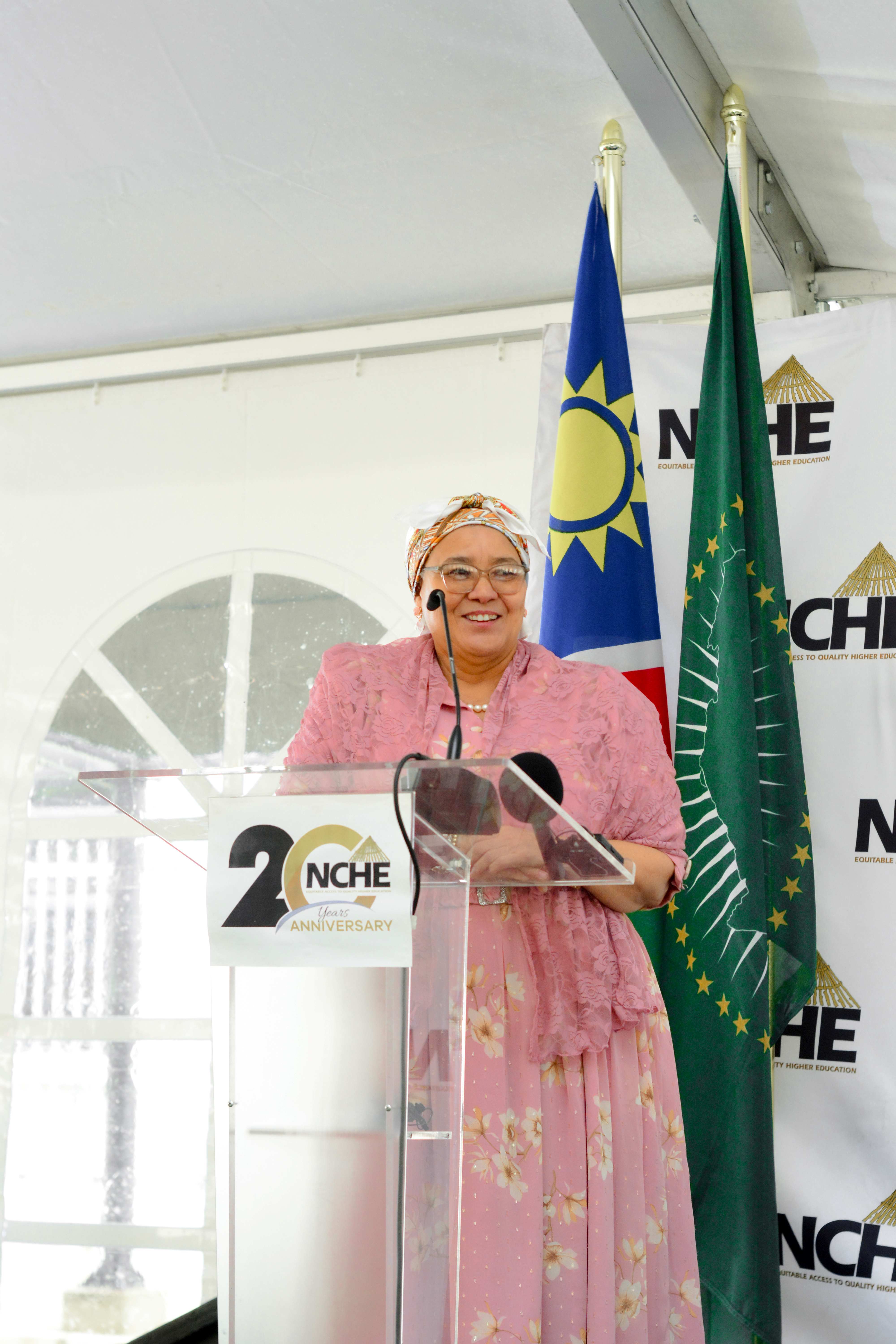
It is with great honour that I stand before you today to mark a momentous milestone in Namibia’s higher educational journey, marking the 20th Anniversary of the National Council for Higher Education (NCHE), and the official inauguration of this office building.We gather here today not only to celebrate two decades of this institution's excellence and the inauguration of this building, but also to institutionalize a lasting legacy by naming this building in honor of a distinguished son of the soil, a national icon, the late Dr. Zedekia Josef Ngavirue. As the founding Chairperson of the National Council for Higher Education, Dr. Ngavirue provided visionary leadership during the Council’s formative years, serving with distinction from its inception in 2006 until 2011.
Today, we pause not only to reflect on two decades of coordinated stewardship of higher education but also to reaffirm our collective commitment to nurturing change, upholding excellence, and positioning education as a central pillar of sustainable national development.
Director of Ceremonies;
The main function of the National Council for Higher Education is to advise on the strategic direction of the higher education system, recommend priorities for funding, and monitor and evaluate the efficiency of quality management policies in higher education institutions.
Together with other educational statutory bodies, such as the National Institute for Educational Development (NIED), the National Examination and Assessment Board (DNEA), the Namibia Training Authority (NTA), the Namibia Qualifications Authority (NQA), and sectoral Professional Councils, the National Council for Higher Education forms an integral component of Namibia’s coordinated education and training architecture.
These institutions collectively advance the aspiration of our National Development Plans. Vision 2030 envisions a prosperous and industrialised Namibia, developed by its human resources, enjoying peace, harmony, and political stability. Education and training, therefore, remain at the heart of national transformation, entrusted with the task of building a unified, flexible, and lifelong learning system responsive to a rapidly changing global environment.
With this mandate, the onus is on National Council for Higher Education, to adopt a proactive, flexi and technology-driven approach to remain relevant in a rapidly changing education system.
Director of Ceremonies;
Over the years, the Namibian Government has consistently invested in expanding access to education through the construction of schools and community libraries, rural electrification initiatives, and curriculum reforms aligned to technological advancement and industrial development.
In the higher education subsector, notable milestones include the establishment of comprehensive quality assurance systems, strengthened industry participation in development, the introduction of the Student Financial Assistance Fund (NSFAF), and the adoption of a public higher education funding framework. These interventions have laid a solid foundation for institutional sustainability, relevance, and accountability.
Furthermore, the Eighth Administration, under the leadership of Her Excellency Dr Netumbo Nandi-Ndaitwah, government has adopted a student funding model that fully subsidises tuition and registration fees for students enrolled at accredited tertiary institutions. In addition, the Minimum Standards for Higher Education Institutions in Namibia and a Policy Framework for Qualifications Standards have been approved. These landmark policy interventions remove financial barriers to learning beyond general education and affirm quality education as both a fundamental right and the foundation of a knowledge-based economy. I therefore urge our young people to actively embrace this opportunity with discipline, purpose, and commitment to excellence.
In this regard, I commend the statutory educational agencies, under the stewardship of Honourable Dr Sanet Steenkamp, for strengthening coordination, harmonisation, and system integration. I was particularly pleased to observe effective teamwork among these organisations, together with the training institutions, in detailing the roadmap for implementing the policy stance on subsidised tertiary education, immediately after the announcement by Her Excellency, Dr. Netumbo Nandi Ndaitwah. I am also happy to learn about the breakthrough made by the National Council for Higher Education and the Namibia Qualifications Authority in concurrent accreditation, as well as their collaboration with the higher education professional bodies.
These efforts reflect a maturing system, one that is increasingly responsive to national development priorities, labour market demands and the aspirations of our youth. Therefore, as we commemorate the 20th anniversary of the National Council for Higher Education, we reaffirm the government’s unwavering commitment to a higher education system that is accessible, equitable, and globally competitive.
Director of Ceremonies;
Over the past twenty years, the National Council for Higher Education has played a central role in shaping policy direction, strengthening institutional oversight, and promoting access and quality across our tertiary institutions. These achievements reflect sustained commitment, collaborative effort, and an unwavering belief in education as a driver of socio-economic transformation.
Yet, as we celebrate progress, we must also look ahead with clarity and purpose. The future of higher education development in Namibia calls for bold innovation, inclusive and forward-looking policy frameworks, strengthened partnerships with industry, and sustained investment in research, digital transformation, and skills development. We must ensure that our institutions remain globally competitive, locally relevant, and responsive to the evolving demands of our economy and society.
Director of Ceremonies;
At this juncture in our programme, it is both appropriate and meaningful that today as we commemorate the 20th anniversary of the National Council for Higher Education, we officially unveil this building, the Dr Zedekia Josef Ngavirue Higher Education House. By honoring Dr Zedekia Josef Ngavirue in this way, we recognize the unforgettable impact he has had not only on this institution, but also his broader contributions to nation-building, reconciliation, and diplomacy.
As the founding Chairperson of the National Council for Higher Education, Dr Ngavirue’s vision helped shape the foundations of Namibia’s higher education governance framework. On behalf of our Government, I extend our heartfelt appreciation to the Ngavirue family for sharing this remarkable patriot with the Namibian nation.
Let us build on our national vision and Dr Ngavirue's legacy to create a higher education system that is globally competitive, locally relevant, and socially just.
May this building stand not merely as a physical structure, but as a symbol of knowledge, integrity, and national aspiration, a living monument to the transformative power of education.
Together, let us continue to nurture change and Honour excellence in the service of our nation.
I thank you!